Showing posts with label China. Show all posts

Saturday

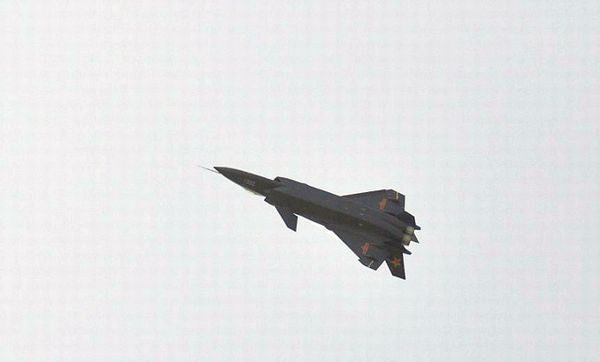
MiG Denies Stealth Technology Transfer To China For J-20 Fighter


Russia has never transferred any stealth technology to China to assist it with its J-20 Black Eagle fifth-generation stealth fighter prototype, Russian plane maker MiG said.

"We are not delivering any equipment to China, and never have," MiG spokeswoman Yelena Fyodorova said.

MiG's statement follows claims in the Russian and foreign press last week that China's J-20, unveiled over six months ago, is based on technology and components from the Russian Mikoyan Article 1.44, a stealth technology demonstrator aircraft, development of which was suspended.

Some analysts say the aircraft have close similarities.


"The back end of the J-20 looks awfully like the 1.44, as does the overall layout with delta canards," said Douglas Barrie, an air warfare specialist at the London-based International Institute of Strategic Studies.

"If it's a coincidence, it's a striking one. Russia may have provided technical support, but there is nothing substantial to prove that. China has however relied on Russia for much of its defense procurement for a decade and a half," he added.

China's J-20 Black Eagle is thought to be conceptually similar to the U.S. F-22 Raptor and the Russian T-50 jets, but is likely to be just a technology demonstrator or prototype rather than a viable fighter.


China has been working on a future fighter program since the mid-1990s, but the J-20 is not expected to enter service before 2018-2020.

Earlier in the month, Mikhail Pogosyan, the head of Russia's United Aircraft Corporation said that China's fifth-generation fighter program is more for effect than substance and branded the maiden flight as a "show-off."

China relied on the Soviet Union for much of its aviation technology until the Sino-Soviet split after 1961. China then carried on developing copies of Soviet and Russian aircraft.

Beijing also relies on Russian engines, radars and electronic components for many of its other aircraft, such as the JF-17 fighter it developed jointly with Pakistan.

"We are not delivering any equipment to China, and never have," MiG spokeswoman Yelena Fyodorova said.

indrus.in

India Prepared To Face The Chinese Threat : IAF Chief

In response to the US official reports of  China  deploying nuclear-capable missiles along the borders with India, the Air Force chief said the country was not 'worried' over these developments as it has own plans to deal with the situation.

"These are all known, it is nothing that we are worried about. We have our own plans and we are moving ahead with our own plans. These are the realities we have to deal with," Air Chief Marshal NAK Browne said in reply to a query. 

The Air Chief Marshal was releasing the brochure for the upcoming two-day 6th International Conference on Energising Indian Aerospace Industry beginning from September 22, 2011 in Delhi.

The US Pentagon reports have said that the Chinese People's Liberation Army has deployed nuclear missiles along the borders. The Chinese government has, however, denied the US reports.

The Indian Navy also denied reports of a London-based newspaper that a Chinese warship had confronted its assault vessel in the disputed South China Sea after it left Vietnamese waters in late July.

"The INS Airavat returned from its scheduled official deployment to Vietnam without any confrontation with a Chinese vessel," Navy spokesperson Commander PVS Satish said in a release.

When asked what India can learn from China in developing its indigenous aerospace industry, the IAF chief said: "One thing that one could learn from them is that they don't attempt to do everything themselves."

"Once you start the Research and Development and then wait and wait, then you make it the test-tube model, it takes you 20-30 years to finalise the project," Browne said.

However Browne was of the view that China got a fair amount of technology from outside.

He said that Chinese were spending a lot of money on R&D. In case of Indian Defence public sector units the investments in R&D is comparatively low.

Browne was of the view of cooperation with the private sector. But he said that the private sector need to upgrade its R&D.

In the recent past, India has deployed its fighter aircraft including the frontline Su-30MKI in Assam and is in the process of upgrading its Advanced Landing Grounds in Ladakh and Arunachal Pradesh.

Asked about its plans to upgrade the Nyoma ALG into a full-fledged airfield, Browne said the proposal was with the Government.

He said that the deal for 126 medium multi range combat aircraft is likely to be signed by the year end.

“The Naresh Chandra Committee is likely to recommend better coordination between the service headquarters and the Defence Ministry,” he said.

The Indian aerospace industry is currently undergoing a phase of rapid growth and progressive transformation. With compound annual growth rate (CAGR) of 18% over the last five years, India has emerged as a major aerospace market. Driven by the increased defence spending, the booming commercial aviation market, rising technological and manufacturing capabilities of Indian industry and robust economic growth, the Indian aerospace industry (civil, military and space), is expected to grow at minimum 12 to 14% annually during the next five years. The changing dynamics of this sector has eventually been unraveling new sets of challenges and opportunities for the industry players prompting them to restructure their short to long-term business strategies.

With maintenance, repair and overhauling (MRO) activities picking up mainly due to the significant and sudden rise in the total fleet size, India is expected to become the hub for aviation MRO facilities. The aviation MRO market in India is expected to outspace the growth in the global as well as in the Asian market very shortly.

The rapid growth of opportunities in this sector has been able to attract major global aerospace companies into Indian aerospace market. As per some estimates, India would require about 1,300 commercial planes worth $150 billion in the next two decades to meet the growing demands. With growing passenger movements and increasing military aviation demand, Indian aerospace sector is going to be the epicenter of opportunities for both domestic and international business communities. The upcoming 6th International Conference on Energising Indian Aerospace Industry in Delhi is likely to deliberate on all these issues.

www.mynews.in

China's Next Generation Fighter Projects-g J-20,J-19 And J-16 Fighter Jets


CAC didn't get all the projects. SAC also got its own 4th gen. Navy's 4th gen will be a competition between the two. Eventhough SAC has more experience with J-15, CAC will be looking to take their pie.

Both design institutes have their proposals (for navy's 4th gen), but competition hasn't start yet. SAC's convention design has more advantage in this area, since it requires little modification. CAC's design require significan altercation. Navy has requirement for stealth and supercruise, as well as supersonic manoevurability. One more thing, navy's 4th gen will be a heavy fighter.


Decent and objective article. J-20's paylod is quite good compared to its size. It's roughly about the size of T-50 and F-22, smaller than Su-27. Competition for avionics is basically done. If it enters service in about 6 or 7 years, its avionics will be roughly on par with F-35 today. And the dimension of its radar will be the largest among all 4th gen (including F-22, F-35 and T-50).

SAC's avionics will be slightly inferior to CAC's. CAC's avionics were chosen from a competitive process. In terms of payload, SAC's design has more flexibility.

2007's competition was between canard design of CAC and tri-wing design of SAC. It is different from current conventional layout project ongoing at SAC at the moment.
Competition for J-20's sub-systems is already over. We're waiting to intergrate and test them on 03 and 04 prototypes.
When completed, we estimate J-20 will have better avionics than current F-22. Among the 4S requirement, two will likely exceed it. Of course, F-22 will still be better in terms of stealth.

J-20's design philosophy is to meet stealth requirement, while emphasizing on manovurability and supercruise, similar to Mr. Song's (designer of J-10) article.

Even if our turbofan engines are on the same level as Americans, we're still likely to use canards in our design.
WS-15 engine will be equipped with 3D TVC. Russians will do the same thing with their engines. Only Americans will use 2D TVC. Each has its pros and cons, depending on what's more suitable for the user, so don't expect F-22 style nozzle on J-20.

CAC and SAC's projects will both be produced, and used in conjunction. All 4th gen are part of our future air combat network.

Originally, SAC did not plan to install TVC on their project, but now the plan has changed.
Don't expect J-20 to carry anti-ship missiles. It's both impossible and unneccessary. J-20's sole focus is air superiority, carrying 6 medium range and 2 short range air-to-air missiles.

China's Mysterious VTOL J-18 Red Eagle Stealth Fighter Jet

Recently, China's VTOL aircraft J-18 become the focus of attention. Phoenix's military observation program focused on 31 August resolve the J-18. Some people think that J-20 high-profile appearance for the J-18 to do a cover, is said J-18 is better than J-20.

The West is disturbed not only the Chinese aircraft market potential, China's J-10 fighter and other advanced technology is that they keep a close eye target. United States, "Defense News" published a news that according to reliable military intelligence revealed that China's new 4.5 generation heavy fighter J-18 (Chinese name "Red Eagle") was officially put at the Shenyang Aircraft long.

Main parameters of the J-18


J-18 China's fourth-generation air superiority fighter. With forward-swept wing design agency, China's fourth air superiority fighter. Can be a successful maiden flight over the U.S. F-22, F-35. Service time is expected around 2015.

(1), J-18 "Red Eagle" parameter:

Wingspan: 15.2 m

Length: 22.4 m

Height: 4.94 m

Total weight: 47 tons

Empty weight: 20.5 tons

Maximum payload: 12.5 tons

Maximum speed: 3100 km / h

Maximum range: 8500 one thousand meters

(2), F-22 "Raptor" parameter:

Wingspan: 13.56 m

Length: 18.92 m

Height: 5 m

Total weight: 36 tons

Empty weight: 13.6 tons

Maximum payload :6-7 t

Maximum speed: 2335 km / h

Maximum range: 4830 one thousand meters

Significance of J -18 offline

Fighter with a lot of advanced technology, complete winning contemporary Western main fighters (3 to 4 generations), the 21st century will be China's air force one mid-battle equipment. United States, "Defense News" also reported that the aircraft has a super-stealth characteristics, and installation of a laser active phased array radar, built-in weapons bay and two large thrust-vectoring engines. "Defense News" emphasized that the U.S. is also an advanced F-22 fighters that do not possess the characteristics. "
  J-18 fighter prototype off the assembly line level indicates that China has fully reached the world advanced level, type of strategic intercontinental aircraft in the lead. In the United States tried to interfere in the Taiwan issue, the more voice and initiative.

As China has been outside of this advanced fighter strictly confidential, so the Western media only from other aircraft performance on China speculation. ITAR reports, when Russian Defense Minister Sergei Ivanov said China, Russia will consider the sale of Su-34 fighters to China, and does not rule out China's participation in the development of fifth generation fighter. Russia made the above statement, in addition to political relations between the two countries, but may also be because the Chinese aircraft manufacturing level has been a major breakthrough, even in some of the leading world level.

U.S. response

Fisher Heritage Foundation in the United States to the US-China Economic and Security Review Commission's report said the middle of China, Shenyang Aircraft Factory production of the J -18 fighter for the U.S. military and homeland security pose a serious threat to the United States must increase the funding and scientific research, the 5th generation fighter in 2009 fielded forces, continue to maintain China's strategic advantage. United States, "Defense News" reports, the U.S. Defense Department will hold an emergency meeting to study the adjustment of the U.S. in Okinawa, Korea, mainland Japan and other Asian bases of military deployment, and is likely to increase in Asia and Taiwan region F-22, F-35's number, in response to "Red Eagle" threat.

Russia's "Global Affairs" magazine also comments that: "We have every reason to believe that China will not like the aircraft manufacturing industry in the 1950s as a replica of a Soviet factory, but go more their own special way of new business, and sincerely hope J -18 successful test flight. " 

George Kennan (the U.S. military commentator): The recent disclosure of U.S. satellite photos, a secret military base in Inner Mongolia, China has a new aircraft in flight frequency tired of it! What? It is the secret of successful test flight of China's current "China's first vertical takeoff and landing fighter aircraft", following the service after the J-20 J-18.

We are here for some of the relevant information is still to us through the past to avoid some of China's "enlightened person" message. However, very little. China to take strict measures a large scale, security agencies and supervision of staff, a large presence in the test site.

The Chinese people learned the past few leaks. They do not allow those technicians to go home, communication. Even cell phones will be checked. Also not allowed to use camera phones as well as all digital cameras.

Now the top of the upper part of its plant, the application of a heavy thickness of lead, zinc laid outside the reflective material. In addition, the device uses the early development of the practice of the Mao era, systematic design is terminated into a group design.

The project includes 13 project teams. Each team can only be responsible for 1-2 projects.

To see his face in fact, unless you can put all the engineering and technical personnel, designers brought together. The overall project designer, designers. So far no detailed information is not available to the outside world.

Open a number of sheets on the network of J-18 took off picture, a picture of them clearly see the front wing, although the picture is fuzzy, blurry photos to forge such, it is very difficult. But can be sure, the U.S. F35
J-18 is a clone of the letter. J -18 fighter aircraft is a VTOL aircraft, it can be said is China's first such aircraft.

Russia, the Chinese military has taken a more mature and direct the design of supersonic cruise aircraft has an excellent ability to do battle with today's performance vehicles have a clear advantage can not be compared.

Although China has repeatedly hidden his whereabouts. However, we still know his through satellite photos on the physical state of the ground there. Test has been going on several times

US ‘CYBERCOM’ May Trigger A New Cyber Warfare: Chinese analysts

The US’ announcement to set up a Cyber Command (CYBERCOM), which is aimed at gaining military supremacy in cyber space, might trigger a new Cyber Warfare Race, Chinese strategic analysts have warned.

“It has already had the lead in conventional military and nuclear forces. Now it is expanding this advantage to be the leading force in new fields, such as electromagnetic space and outer space,” state-run China Daily quoted Peng Guangqian, a Beijing-based strategist, as saying.

US Secretary of Defence Robert Gates, recently, announced the establishment of the world’s first comprehensive, multi-service military cyber operation, called CYBERCOM, which could provide US forces a lead in new emerging strategic fields like space and outer space.

The announcement came only a few days after President Barack Obama laid out his National Security Strategy, stressing for the first time in such a document the importance of cyber security as one of the core national security interests, he said.

Meng Xiangqing, a professor with the National Defence University said there is a very thin line between a defencive and an offencive act when it comes to cyber space.

“CYBERCOM ranks high in the US military, reporting directly to the US Strategic Command, and the US is the most advanced state in cyber technology. This absolute advantage may trigger a new type of arms race,” Meng said.

Despite the US insisting CYBERCOM is mainly defencive, Meng said it “has raised a new challenge for China, and that is how to guard our national cyber security.”

States other than the US have already been planning mechanisms to guard national cyber security, including the UK, France, Russia, South Korea and Israel, which already has a military cyber force.

Song Xiaojun, a Beijing-based military strategist, said even if other countries join in the cyber arms race, they are not capable of competing with the US since it possesses the core technologies of the Internet and of all 13 Internet root servers in the world, 10 are in the US, including the only one main root server.

The newspaper also reported the comments of US Deputy Defence Secretary William J Lynn III that the potential enemy that CYBERCOM will fight has not yet been clearly identified.

“I think we need to be prepared for the unexpected. In fact, over the past several years we have experienced damaging penetrations,” Lynn had said apparently referring alleged attempts by Chinese hackers to break into sensitive defence sites. 


http://www.china-defense-mashup.com/

NATO And India Would Work Together For Busting Chinese Hackers

Faced with a common cyber security threat from Chinese hackers, NATO is eyeing India as an ally in securing its computers that hold sensitive information and data against malware and Trojan viruses.

With US already signing a cyber security collaboration pact with India this July, the 28-nation American-led political and military alliance is of the view that it can collaborate with the South Asian information technology superpower in protecting the cyber world, one of the global commons.
"You have one of the most advanced cyber industries in the world... and information technology industries. The issue of cyber security is one that affects the United States, NATO and India no matter whether we are aligned or non-aligned," a senior NATO official told IANS at the alliance's headquarters here.

"The cyber world doesn't recognise alignments. It only recognises switches and servers. As a result, we are in this cyber world together, whether we like it or not.

"We better figure out a way to cooperate, particularly since it does matter that you have a neighbour (country) next door, which is pretty much involved in cyber issues, even far away. Because in the cyber world, we are equally close," the official, who did not want to be identified because of the organisation's rules, said.

Although he did not name any of India's neighbours, it was clear he was referring to China, which is suspected of being behind spy software attacks on American, NATO, Indian and Tibetan computers in the last half-a-decade, stealing highly classified military and security data.

In 2009, an investigation by Information Warfare Monitor (IWM) comprising researchers from Ottawa-based think-tank, SecDev Group, and the Munk Centre for International Studies at the University of Toronto, had blamed a spy network of Chinese hackers, called GhostNet, to have breached the firewalls of computers of NATO and other countries, including that of Tibetan leader Dalai Lama.
Their 2010 report claimed that major Indian defence establishments, including the Institute of Defence Studies and Analyses, National Security Council Secretariat, National Maritime Foundation, and armed forces units were targeted and secret presentations on weapons systems stolen by Chinese hackers.

A cyber security report earlier this year had suggested that the worldwide web-based attacks in 2010 were up 93 per cent from 2009.

As recently as July this year, 'Anonymous' hackers had targeted NATO in a cyber attack.
Just a month ahead of the latest attack, NATO had decided to create a special task force to detect and respond to such attacks by beefing up its cyber defence capabilities.

Its 2010 summit in Lisbon too recognised the growing sophistication of cyber attacks and set policies for the alliance to cooperation with partner countries.

NATO has already spelt out its intention of having India as a political and military partner country, considering its growing stature as a regional power.


http://ibnlive.in.com/

China Made AC-313 Helicopter Hits New Heights


China's domestically developed civilian freight helicopter, the AC313, successfully climbed to a height of 8,000 meters, an altitude that will enable the chopper to fulfill plateau missions.
The AC313, developed and manufactured by the Aviation Industry Corporation of China (AVIC), hit its highest altitude to date during a trial flight on Sept. 2 at Gonghe Airport in northwest China's Qinghai Province, AVIC said in a statement Tuesday.
"The test flight has fully proven the helicopter's function and reliability, and will decide the range of its flight altitude," said Xu Chaoliang, chief engineer of the AC313.
The helicopter, with a Maximum Takeoff Weight of 13.8 tons, can be used for transportation, forest fire prevention, emergency search and rescue missions, disaster relief and medical aid.
The AC313 completed its maiden flight in March 2010.

Thursday

China Preparing For Future Fight With US


The Iraqi war has convinced the Chinese Communist Party (CCP) leadership that some form of confrontation with the U.S. could come earlier than expected.

Beijing has also begun to fine-tune its domestic and security policies to counter the perceived threat of U.S. "neo-imperialism."

As more emphasis is being put on boosting national strength and cohesiveness, a big blow could be dealt to both economic and political reform.

That the new leadership has concluded China is coming up against formidable challenges in the short to medium term is evident from recent statements by President Hu Jintao and Premier Wen Jiabao.

Hu indicated earlier this year Beijing must pay more attention to global developments so that "China make good preparations before the rainstorm ... and be in a position to seize the initiative."

Wen also pointed out in the first meeting of the State Council, or cabinet, last Saturday the leadership "must keep a cool head."

"We must boost our consciousness about disasters and downturns -- and think about dangers in the midst of [apparent] safety," he said.

Alarm bells about a deteriorating international situation have been sounded by the CCP's secretive Leading Group on National Security (LGNS), which coordinates policies in areas including diplomacy, defense and energy.

The LGNS, which is headed by Hu, has since early this month called a series of meetings to discuss ways to handle the Iraqi crisis.

In the near term, of course, the focus is on the impact of rising oil prices -- and on the need to build up a strategic oil reserve that can last at least 30 days.

However, economic concerns are not the top priority. Given the likelihood oil prices will drop after the resolution of the conflict, some government economists are saying the war's impact on this year's economic performance will be insubstantial.

Officials even cite the safe haven theory to predict foreign direct investment flowing into China will exceed the record $52 billion last year.

Of more concern to the LGNS is the perceived expansion of American unilateralism if not neo-imperialism.

As People's Daily commentator Huang Peizhao pointed out last Saturday, U.S. moves in the Middle East "have served the goal of seeking world-wide domination."

State Council think-tank member Tong Gang saw the conflict as the first salvo in Washington's bid to "build a new world order under U.S. domination."

Chinese strategists think particularly if the U.S. can score a relatively quick victory over Baghdad, it will soon turn to Asia -- and begin efforts to "tame" China.

It is understood the LGNS believes the U.S. will take on North Korea -- still deemed a "lips-and-teeth" ally of China's -- as early as this summer.

These developments have prompted China to change its long-standing geopolitical strategy, which still held true as late as the 16th CCP Congress last November.

Until late last year, Beijing believed a confrontation with the U.S. could be delayed -- and China could through hewing to the late Deng Xiaoping's "keep a low profile" theory afford to concentrate almost exclusively on economic development.

"Now, many cadres and think-tank members think Beijing should adopt a more pro-active if not aggressive policy to thwart U.S. aggression," said a Chinese source close to the diplomatic establishment.

He added hard-line elements in the People's Liberation Army (PLA) had advocated providing weapons to North Korea to help Pyongyang defend itself against a possible U.S. missile strike at its nuclear facilities. Forestalling the challenge Hu was elected president of China by the NPC this month. Hu was elected president of China by the NPC this month.

Even less hawkish experts are advocating beefing up the national security apparatus.

Chinese Academy of Social Sciences (CASS) economist Yang Fan pointed out the recent global flare-ups had alerted China to the imperative of improving national security and cohesiveness.

"Equal weight should be given to economic development and national security," Yang said. "As we become more prosperous, we must concentrate our forces [on safeguarding national safety]."

What is China doing to forestall the perceived U.S. challenge?

Firstly, the CCP leadership is fostering nationalistic sentiments, a sure-fire way to promote much-needed cohesiveness.

While not encouraging anti-U.S. demonstrations, Beijing has informed the people of what the media calls "increasingly treacherous international developments."

This explains what analysts including Beijing scholars considered the unexpectedly virulent official reaction to the start of the Iraq war.

Foreign Ministry spokesman Kong Quan said the U.S.-led military campaign had "trampled on the U.N. constitution and international law" and that it would lead to regional and global instability.

Equally tough statements were issued by the National People's Congress (NPC) and the advisory Chinese People's Political Consultative Conference.

Major official media such as Xinhua and People's Daily have run dozens of articles and analyses whose gist is that, in the words of commentator Li Xuejiang, the invasion of Iraq had "damaged the international order."

In an apparent departure from Beijing's cautious attitude at the beginning of the Iraqi crisis, authorities last weekend allowed a group of nationalist intellectuals to hold a conference condemning U.S. "hegemonism."

The corollary of boosting national cohesiveness could be the suppression of dissent, particularly politically incorrect views expressed by "pro-West" intellectuals.

The warning and punishment that party authorities recently meted out to several Beijing and provincial publications may augur a relatively prolonged period of ideological control in the interest of promoting "unity of thinking."

On the economic front, the authorities may play up the imperative of concentrating resources to boost China's "economic security" and "energy security."

"The Wen leadership is checking out why earlier plans to build up a strategic oil reserve failed to materialize last year, when prices were much lower," said a Beijing-based party source.

"It is possible that bucking the overall trend of market reforms, Beijing may bring back more government fiats to sectors deemed to have strategic and national-security implications."

It is instructive that in his 90-minute long interview with the international media last week, Wen was quite reticent about boosting economic reform such as the liberalization of state-owned enterprises.

In accordance with the theory of "the synthesis of [the needs of] war and peace," civilian economic projects in areas including infrastructure may be planned will the requirements of the defense forces in mind.

On the military front, the Iraqi conflict will kick start another season of accelerated modernization of weaponry.

Diplomatic analysts in Beijing said PLA officers and strategists had been scrutinizing the latest hardware used by American and British forces.

They pointed out the PLA's astonishment at the wizardry of American firearms used in the 1991 Gulf War was a major factor behind the Chinese army's aggressive modernization drive through the 1990s.

Academy of Military Sciences (AMS) expert Peng Guanqian pointed out that the Iraqi war would provide the Pentagon with "a testing ground for new military equipment and strategies."

The Liberation Army Daily last Friday quoted unnamed officers from the Army and the People's Armed Police as saying the PLA must "quicken the pace of military modernization."

Such developments could in turn hasten a possible showdown between the two countries that harbor deep-seated mistrust of each other even in relatively tranquil times.

Also see:

The Pentagon is preparing for the first visit to the United States by a high-ranking Chinese military officer in years.

New War Ahead: China-Pakistan vs. U.S.A


China has been deploying thousands of soldiers in the strategic Gilgit-Baltistan, a mountainous area in northern Pakistan, and a region historically contested by Pakistan, India and its inhabitants.
Although cooperation between Pakistan and China is not new -- it was China in the 1970s that supported Pakistan's attempts to acquire its nuclear capability -- the deployment of Chinese troops in Pakistan, however, indicates a worrying alliance for the US. The US would do well to monitor these developments before a catastrophic scenario, especially for its troops, takes place.
The presence of the Chinese People's Liberation Army [PLA] in the contested Gilgit-Baltistan region, where a nascent revolt against the Pakistani rule is taking place, constitutes the direct involvement of Beijing in the dispute over Kashmir, making any future understanding between Pakistan and India more difficult, and can only arouse a new and serious rift between New Delhi and Beijing.
According to Mumtaz Khan, director for the International Centre of Peace and Democracy in Toronto, many Western analysts who view China's stance merely as a bargaining chip against India will unfortunately soon realize that China is redefining its priorities and interests in South Asia and beyond. "The current involvement of China in Gilgit-Baltistan and Pakistan administered Kashmir consists of more than just providing military and diplomatic support to Pakistan. Soon, Pakistan will swap its role to take the backseat as China exerts itself as a major player in the Kashmir issue" and maybe also in Afghani one.
The Gilgit-Baltistan region borders Afghanistan to the north; China to the northeast; the Pakistani administrated state of Azad, Jammu and Kashmir (AJK) to the south, and the Indian-administered state of Jammu and Kashmir to the southeast. Recently, the New York Times reported that two major developments are taking place there: a rebellion against the Pakistani rule, and the influx of an estimated 7,000 to 11,000 soldiers of the PLA.
China's Grip on Pakistani Strategic Area
"China wants a grip on the strategic area to assure unfettered road and rail access to the Gulf through Pakistan," stated the NYT. Beijing intends to create a corridor from the Indian Ocean up to the Chinese province of Xinjiang. The first cornerstone of this grandiose project has been the construction of the Gwadar Port, at the mouth of the Persian Gulf and outside the Strait of Hormuz. It is near the key shipping routes used by the mainline vessels that have connections to Africa, Asia and Europe, and it enjoys a high commercial and strategic significance.
The port was financed and built by China and inaugurated in 2007 by the former Pakistani President Pervez Musharraf. At present, it takes a Chinese tanker about 16 to 25 days to reach the Gulf. Once high-speed rail and road links through Gilgit-Baltistan are completed, however, China will be able to transport cargo to and from Xinjiang to Gwadar and to other Pakistani port facilities, within 48 hours.
PLA's soldiers in Gilgit-Baltistan are also expected to work on the infrastructure in the region. According to reports, China is planning the construction of roads and bridges; a high-speed rail system, and nearly two-dozen tunnels. As the whole area is closed to foreign observers, news can only be obtained through intelligence information, as well as satellite imagery that shows construction activities are underway throughout the region.
Many of the PLA soldiers are supposedly currently building the railroad. Others are extending the Karakoram Highway, which connects China and Pakistan across the Karakoram mountain range, and engaged in activities for constructing dams, expressways and other projects.
Their presence is also apparently meant to deter any possible disturbances from the local population, within which are simmering rebellious sentiments against the Pakistani rule.
China and Pakistan's Common Interest is India
The presence of Chinese soldiers on Pakistani soil is not an ordinary matter. If all Pakistani governments have always objected to the deployment of U.S. troops in the country, why is there such openness towards the Chinese army?
The alliance between the U.S. and Pakistan appears to be becoming less and less sound. The U.S.-led war against the Taliban, Al-Qaeda, and other terrorist groups in Afghanistan is quickly deteriorating into a growing open conflict with Pakistan's Inter-Services Intelligence (ISI)., which represents the core of Pakistani military power and can also act independently from Pakistan's government. The agency is responsible for the creation of the mujahiddin movement in Afghanistan during the war against the USSR; and later, for the movements for the "liberation" of Kashmir, as well as the first attack on World Trade Center, and the attacks on hotels and a Jewish Habad Cenmter in Mumbai. . The main ISI's concern, however, is India's rule in Kashmir. This is why the ISI, in order to confront New Delhi, is providing help and shelter to Islamist groups ready to fight for the "Muslim" Kashmir.
China and Pakistan share many common interests: both have territorial disputes with India. China and India, whose populations, combined, make up slightly less than 40% of the world population. They are also both striving for strategic regional supremacy. By linking its western province to the Indian Ocean, China will not gain just a strategic stronghold and access to the Persian Gulf, but also could significantly influence the geopolitics and trade in the Indian Ocean Region, as well as in Central Asia.
A Possible War Between Pakistan/China and the US
The possible scenarios coming out of the present situation are also dangerous. A deterioration of the relations between the U.S. and Pakistan over the war in Afghanistan could lead to a direct confrontation -- in which event, the involvement of the giant China, as Pakistan's ally, might be inevitable. The Middle East Media Research Institute (MEMRI) reports that already a delegation of the Chinese Army visited the Pakistan-Afghan Border last October[5].
The same MEMRI's analysis also predicts that in a possible war between Pakistan/China on the one hand and the US on the other, Russia would be on the side of the West. Russia's First Deputy Prime Minister, Sergei Ivanov, has said that Russia does not want the international troops to leave Afghanistan. Moscow, concerned about development in this region, has begun strengthening the Afghan police forces by supplying weapons and ammunition.
In the meantime, the relationship between Pakistan and Russia are marred by the Cold War legacy, and will take a long time to get normalized. MEMRI reports that the Urdu-language Pakistani daily Roznama Nawa-i-Waqt has warned that "another enemy of Pakistan" –. Russia – has been added to the list of the countries influencing Afghanistan; and that the presence of Russian troops in Afghan will reinforce anti-Pakistan forces in Afghanistan.
Conclusion
Before apocalyptic scenarios become a reality, it would help if Washington exerted exert maximum efforts -- and firmness -- to convince Pakistan not to continue on such a dangerous path. Two new war fronts seem rapidly to be opening: Afghanistan on one side, and Kashmir on the other.. The explosion of a possible war could involve both fronts, the Afghani and the Kashmiri, where the US ally, India, might pay a heavy price, finding itself between two enemies: Pakistan and China.
The US will admittedly have a hard role, given the fact that relations between the Washington and China are already fragile, especially since the "Star Wars arms race" launched by China in 2007, but it is urgent that serious efforts be made.

source

Another U.S. War? Obama Threatens China and Iran

The possibility of yet another U.S. war became more real last week, when the Obama administration sharply confronted both China and Iran.  The first aggressive act was performed by Obama’s Secretary of State, Hillary Clinton, who “warned” China that it must support serious economic sanctions against Iran (an act of war). 
Clinton said: “China will be under a lot of pressure to recognize the destabilizing effect that a nuclear-armed Iran would have, from which they receive a significant percentage of their oil supply.”

The implication here is that China will be cut off from a major energy source if they do not support U.S. foreign policy — this, too, would equal an act of war. 

A more direct military provocation occurred later when Obama agreed to honor a Bush-era military pact with Taiwan, a small island that lies off the mainland coast of China, and is claimed by China as its own territory. Taiwan has been a U.S. client state ever since the defeated nationalist forces fled there from China in the aftermath of the 1949 revolution. Taiwan has remained a bastion of U.S. intrigue and anti-China agitation for the past six decades.  Obama has recently upped the ante by approving a $6.4 billion arms sale to Taiwan, including:
“... 60 Black Hawk helicopters, Patriot interceptor missiles, advanced Harpoon missiles that can be used against land or ship targets and two refurbished minesweepers.”  (The New York Times, January 30, 2010). 
The same article quotes a Chinese government official who responded, accurately, by calling the arms sale “… a gross intervention intoChina’s internal affairs, [and] seriously endanger[ing] China’s national security…”   In 1962, When Russia supplied missiles to Cuba, nearFlorida’s coast, the U.S. interpreted this to be an act of war. 

China responded harshly to the Taiwan arms deals, imposing “an unusually broad series of retaliatory measures… including sanctions against American companies that supply the weapon systems for the arms sales.”  These U.S. arms manufacturers are giant corporations who have huge political influence in the Obama administration, and are likely to further push the U.S. government towards an even more aggressive response.    

Obama’s polices against China have been far more aggressive than Bush’s, making a farce out of his campaign promises of a more peaceful foreign policy. Obama’s same, deceitful approach is used inSouth America, where he promised “non-intervention” and then proceeded to build military bases in Colombia on Venezuela’s border, while giving a green light to the coup in Honduras. 

Hillary Clinton also threatened China about internet censorship last week, while Obama consciously provoked China by agreeing to talks with the Dalai Lama, who advocates the removal of Chinese influence from Tibet.

Still fresh in the memories of both the U.S. and China is the recent trade flair up, when Obama imposed taxes on Chinese imports; and China responded with protectionist measures against U.S. companies, which brings us to the heart of the matter. 

The attitude of the U.S. government towards China has nothing to do with the Dalai Lama, internet censorship, or human rights.  These excuses are used as diplomatic jabs in the framework of a larger, geopolitical brawl. Chinese corporations are expanding rapidly in the wake of the decline of the U.S. business class, and Obama is using a variety of measures to counteract this dynamic, with all roads leading to war. 

This grand chessboard of corporate and military maneuvering reached a dangerous standoff yesterday, with the U.S. military provoking Iran. The New York Times explains:
“The Obama administration is accelerating the deployment of new defenses against possible Iranian missile attacks in the Persian Gulf, placing special ships [war ships] off the Iranian coast and antimissile systems in at least four [surrounding] Arab countries, according to administration and military officials.” (January 30, 2010). 
The same article mentions that U.S. General  Petraeus admitted that “… the United States was now keeping Aegis cruisers on patrol in the Persian Gulf  [Iran’s border] at all times. Those cruisers are equipped with advanced radar and antimissile systems designed to intercept medium-range missiles.”  Iran knows full well that “antimissile systems” are perfectly capable of going on the offensive — their real purpose. 

Iran is completely surrounded by countries occupied by the U.S. military, whether it be the mass occupation in Iraq and Afghanistan, or the U.S. puppet states that house U.S. military bases in Arab nations.  Contrary to the statements of President Obama, Iran is already well contained militarily.  Iran’s government — however repressive it may be — has every right to defend itself in this context. 

It is possible that these aggressive U.S. actions will eventually force Iran’s government to act out militarily, giving the U.S. military the “defensive” excuse it’s been waiting for, so the tempers of the U.S. population can be cooled. 

A separate New York Times editorial outlines the basic agreement onIran shared by the Democrats and the Republicans.  It says:
“It is time for President Obama and other leaders to ratchet up the pressure with tougher sanctions.”
And: 
“If the [UN] Security Council does not act quickly, then the United States and Europe must apply more pressure on their own [Bush's Iraq war strategy]. The Senate on Thursday approved a bill that would punish companies for exporting gasoline to Iran or helping Iran expand its own petroleum refining capability [another act of war]” (January 29, 2010).
The U.S. anti-war movement must organize and mobilize to confront the plans of the Obama administration.  Obama’s policies not only mirror Bush’s, but have the potential to be far more devastating, with the real possibility of creating a wider, regional war.  Iran and China are far more militarily capable than puny Afghanistan or Iraq; the consequences of a war with either will cause countless more deaths. 
source

China Develops Stealth Fighter Military Technology


China is developing new 5th generation "stealth" fighter, which is being developed under a programmed variously referred to as XXJ, J-X, or J-XX by Western intelligence sources and is apparently designated as J-14. Here, Coniglio details China's internal installations and full scale development of J-14.

 
The first picture has recently become available of the new Chinese 5th generation "stealth" fighter. The aircraft, which is being developed under a programme variously referred to as as XXJ, J-X or J-XX by Western intelligence sources (the real Chinese name is not known), is apparently designated as J-14.

The aircraft in the above photo looks at first sight as a complete prototype, but it  
actually is a very detailed full-scale engineering mock-up. It can be speculated that, after having been used to study the aircraft's internal installations, the mock-up has also received an external finish for presentation purposes. Its real function at this point, however, is probably to buttist in the definition of the required logistic support (i.e., access to the various avionics boxes and on-board systems, ground support equipment like the various ladders and the external power source units, air conditioning units and so on) as well as to study the engines' removal-installation procedures.


Since some time now it has been known that the rapidly-developing Chinese aeronautical industry is studying a new and technologically very advanced combat aircraft, also boasting significant low signature characteristics. This programme is a logical step in China's "Long March" towards full independence in designing, developing and producing combat airplanes of a technological level in line with China's status as the "other" world superpower, on an equal footing as Russia and eventually even the USA.

The scarce information available about this new advanced combat aircraft indicates that two, possibly competing, study groups (both part of the AVIC I Group of aeronautical industries) are or have been working on the subject. One of these groups (601 Insbreastute) originates from Shenyang Airplane Corporation (SAC) which is in charge of the large, twin-engine J-8 fighters in service with the PLAAF (People's Liberation Army Air Force) as well as of licence production of the Su-27SK under the local designation of J-11. The overall configuration of SAC's preliminary design, apparently designated J-13, owes significantly to the American F-A-22, being a tailed delta but with wing and horizontal tailplanes more in line with those of the F-16. The other study group (611 Insbreastute) from Chengdu Airplane Corporation (CAC), has developed the J-12, a concept which follows the less conventional canard layout used with success in the company's J-10.

While previous information (albeit admittedly unconfirmed), gave to the SAC concept the edge, perhaps as a result of the company's experience in large twin-engine fighters, this seems to have since been reversed in favour of the Chengdu design. It is however still not clear whether the designation of J-14 is intended to suggest a successor design to both the J-12 and the J-13, and whether the existence of the J-14 engineering mock-up (clearly based on the J-12) indicates that the type has been selected for development, or the compebreastion is still going on with parallel activities underway on another such mock-up based on the J-13.

While no data is available about the J-14, some speculation can be done in the attempt to extrapolate the aircraft's characteristics and thus the roles it is called to perform. The following considerations are based on what can be seen in the photo, but also involve making some buttumptions on the basis of what is known of the Chinese armed forces' perceived priorities in operational requirements, the domestic industry's approach to combat aircraft design and, finally, the well-know Chinese weaknesses in some technological fields. In addition, the well-developed cooperation with Russian companies, particularly in areas such as powerplant, avionics and possibly computer-based fly-by-wire flight control systems is also taken into consideration.
General Configuration

The J-14 will surely be fitted with a fly-by-wire flight control system and be designed for artificial stability. The Chinese should by now have matured an adequate experience in this field through a number of experimental programmes and application to actual in-service types.

The general configuration of the aircraft is clearly born out from CAC's experience in developing the J-10, with its canard layout and ventral air intake. But while the J-10 is known to be related to the Israeli LAVI, this new and much more ambitious design rather appears to have a definite relationship with the ill-fated Russian 5th generation fighter studied a few years ago, the MiG 1.44 MFI and in fact it shares a number of elements which can doubtless be traced back to the Russian demonstrator. It is thus very probable not to say certain that an agreement has been reached between the Russian and Chinese governments allowing for the transfer of information and technological data as well as consultancy services being provided by RSK MiG and Russian research centres (arguably including the TsAGI aerodynamic research insbreastute) to develop the new Chinese fighter.

The J-14's planform closely matches that of the MiG 1.44, i.e. a canard layout (the canard surface are fully movable) with mid-positioned wing and widely separated twin-vertical surfaces canted outward, which continue under the wing in twin ventral fins, these too being canted outward Ă  la J-10. While not visible in the photo, wind tunnel models show that the 1.44 configuration has been maintained also in the booms protruding from the wing and contributing to support the vertical tailplanes and ventral fins. These booms probably end with radomes covering electronic warfare antennas and possibly also a rearward facing radar, similar to the installation experimented in the Su-37 a few years ago. In the MiG 1.44, the portion of wing between the fuselage-engine pods and the booms is extended rearward past the wing trailing edge and includes a couple of moving surfaces contributing, together with the all-moving canard surfaces, to the longitudinal control of the airplane. It is not yet possible to buttess whether this solution, too has been maintained for the J-14.

But while the overall aerodynamic configuration of the J-14 follows that of the MiG 1.44 demonstrator, a radical redesign has been implemented in the pursuit of a significant reduction in the radar cross-section value. In particular, the aircraft incorporates a pronounced wing-body blending, which was totally lacking in the original Russian design. Further, the air intake, while in the same ventral position under the forward fuselage, has a completely new shape, and by the same token the upper part of the airplane is also completely different and shows towards the rear the protuberances of the engine "pods" which blend with the fuselage and wing roots in a curious reminiscence of the Northrop YF-23. Also, the front fuselage merges down into the upper wing, blending with the separated engine bay bulges while maintaining some relation with the "clbuttical" Su-27 forward fuselage shape. The search for enhanced stealth performance is also apparent in the "flattened" profile of the entire front fuselage section (nearly identical to the Su-32), as well as in the generalised use of serrated doors to cover the landing gear and missile bays.

On the other hand, it remains clear that a canard configuration is hardly the ideal solution from the point of view of a reduced radar signature. Summing up, it would thus seem safe to buttume that the J-14 is a "stealth-optimised" aircraft rather than un uncompromising stealth design Ă  la F-A-22 or (in a different clbutt) the F-35 JSF.

Above the raised front fuselage is located the single-seat pilot chickenpit. This is closed by a single-piece frameless bubble-type transparent canopy which appears technological very demanding under various aspects such as manufacturing process, adequate optical qualities and bird-impact resistance, yet allowing through-ejection. On the other hand, the pilot is provided with superb all-around visibility also due to the position of the chickenpit above the forward fuselage "hump", again a reminiscence of the Su-27.
After Chinese visit ships, U.S. officials hope for reciprocation
After Chinese visit ships, U.S. officials hope for reciprocation {EXCERPT}, by Allison Batdorff, Stars and Stripes Pacific edition, Friday, June 23, 2006 ANDERSEN AIR FORCE BASE, Guam ˜...

The main landing gear, with single wheels mounted on telescopic legs, retracts outward, with the legs being accommodated in the fuselage side blending into the wing bottom and the wheels into the wing (a similar geometry has been selected for the F-A-22). In order to minimise the volume of the bay occupied by the gear in the retracted position, the telescopic main gear legs are shortened via a pulling bar acting on a lever, similarly to what has been introduced in the Eurofighter TYPHOON. While not clear in the photo, it is possible that the same landing gear leg shortening design has also been selected for the nose twin-wheel element.
Powerplant Installation

In view of the twin-engine layout of the J-14 and its estimated TO weight in air combat configuration (some 25-28 tons with full internal fuel, gun ammunition, 2 x SRAAM and 4 x MRAAM), its engines should give a thrust in the range of 13-14 tons in afterburning mode, so achieving a thrust-to-weight ratio in the order of 1:1. Now it seems difficult to envisage a stateof-the-art Chinese engine, particularly in this thrust clbutt, achieving full production status by the mid of the next decade when the J-14 could reasonably be expected to enter service. Even for the J-10 a Russian engine has been at last preferred. It can thus be buttumed that a Russian engine has been selected for the J-14 as well, and indeed the model which can be seen in the picture to the rear of the right wing of the mock-up has the accessory gearbox mounted above the engine in the traditional Russian style. If, as it is highly probable, this engine is a member of the Saturn-Lyulka AL-31-41 family (but it could also be a prototype of the Chinese Liming LM WS10A in the same thrust clbutt), this would make the type not fully interchangeable with the version selected for the J-10, which has the accessory gearbox located on the engine bottom, Western-style. It is also possible to speculate that the idea is to have the prototypes powered by the lower-thrust AL-31 as used in the J-11-Su-27SK-Su-30MKK, with either an evolved higher-thrust version of AL-31 or a series-production version of the AL-41 being then adopted for the series aircraft.

Coming to the engine-airframe installation, the air intake located in the bottom part of the front fuselage is of the fixed geometry type with no moving ramp, unlike the case with the J-10. This solution has made it possible to eliminate the sharp angles and slots between the moving ramp and in general to provide smooth shapes which reduce radar reflectivity. The pronounced bulging up of the air intake inner duct helps avoid a direct presentation of the critically reflective engine fan-compressor face to enemy illuminating radar from the forward emisphere. In addition, the bulge is needed to make room for the nose landing gear bay and, even more, for the bottom fuselage weapons bay. Notwithstanding its fixed geometry, the air intake shows elements which should generate a couple of oblique shock waves before the normal one, thus guaranteeing an adequately efficient dynamic pressure recovery in the supersonic flight regime. The well-shaped bulge along the bottom of the centre fuselage entering the air intake, which forms the upper part of the air intake duct, seems reminiscent of the latest Lockheed Martin's vaunted design for a fixed-ramp, multi-shock air intake planned for use on the production F-35 and already experimented on an F-16. This peculiar layout, together with the forward-raked air intake lip (already seen in the late 1950s on the F8U-3 CRUSADER III) is clearly intended to generate the oblique shock waves mentioned above.

The location of the air intake under the fuselage is well suited to provide a smooth distortion-free airflow to the engines. From this particular point of view, the hinged bottom lip present in the TYPHOON works even better at extreme angles of attack, but it implies the penalty of a higher radar signature. In more general terms, the choice of a single air intake configuration in a twin-engine airplane may be open to some criticism, in that it is less than ideal to maintain correct working conditions (i.e., smooth undistorted airflow to the remaining engine) in the event of an engine flaming out for whatever reason. The air intake thus establishes a potential single point failure in an otherwise completely redundant twin-engine installation.

It can be expected that Thrust Vector Control (TVC) nozzles, probably of the axisymmetric type (despite their not insignificant contribution to overall nuclear signature), will be a standard feature of the J-14 to both enhance manoeuvrability and reduce trim drag in cruise flight.
Armament

Chinese design derived from a Russian model such as the GSh-6-23 23mm installed in the MiG-31 and the Su-24. The gun is installed in the upper right fuselage side, just above the canard surface. The firing port, unlike the F-A-22 is left permanently open, hence generating a not so negligible radar reflection.

The main armament is carried in three weapons bays, whose arrangement looks like virtually a clone of the F-A-22. Two smaller bays are located on the fuselage sides and appear to be tailored to each accommodate a single short-range air-to-air missile, while the large underfuselage bay, closed by twin doors, will probably accept at least four medium-range AAMs. It may be speculated that the J-14 is intended to carry "compressed carriage" clipped-wing versions of the AAMs already in use with the PLAAF, i.e. the PL-8 and the Russian R-73 for short-range dogfights and the R-77 and the indigenous PL-12 for medium-range work. The R-77 is already suitable for carriage in an internal bay in its standard version, being equipped with very small span wings while the lattice tail control fins can be fold forward flush with the missile body.

Underwing store stations are surely foreseen to carry additional weapons and fuel tanks, when there is no need to maintain a high level of stealthness.
Combat Avionics

  J-14 is already in full-scale development, the main choices related to the avionics systems should have already been made, at least at the conceptual level. However, the Chinese domestic industry is almost certainly not in a position to supply the advanced avionics required in a sophisticated aircraft like the J-14, and contributions from abroad will be required - from Russia, Israel and arguably even Europe.

The J-14 being intended to enter service in around 2012-2015, it may be expected that the Chinese are aiming at equipping it with a radar with electronically scanning (ASEA) antenna, capable of multiple targets engagements - provided that a source for such a radar could be identified. In the Russian tradition, a pbuttive search and track system based on optronic devices (FLIR with integrated laser rangefinder) is expected to be also installed in a retractable or faired turret. As already mentioned, the dual rear booms could carry, in addition to various pbuttive and-or active defensive systems also a rear-facing radar.

Finally, it can be expected that the chickenpit instrumentation for the production version will be based on an Helmet Mounted Display-Sight (HMD-S) totally replacing the HUD, although the latter instrument is clearly visible in the photo. The head-down displays would probably include three or four large Multi Function Displays (MFD), which should have the possibility to present a digital map and a complete tactical situation. A real-time data link is also an expected addition to the fully integrated avionics system to enhance the situation awareness of the pilot, particularly when operating in multiships combat groups to make the most use of the commonly available information from the various platforms.
Operational Aspects

The most likely enemies that China can expect to have to confront in the future are India and the USA, this latter possibly as a result of a Chinese attempt to follow a military option against Taiwan. Both of these potential enemies have powerful air forces equipped with large fleets of state-of-the-art fighters and fighter-planters trained to operate, in particular the Americans, as complex expeditionary forces, well balanced in their different components and supported by a network of other essential buttets like satellites, AWACS airplanes, dedicated electronic warfare types, aerial tankers, and more in general a whole array of "force multiplier" elements. Given the expected operational environment, the air defence-air superiority role is obviously the PLAAF's #1 priority, with surface attacks against powerful naval forces with strong aerial support (i.e., the US Navy carrier task forces) coming possibly as priority #2.

Hence, it is not surprising that the most advanced Chinese combat airplane ever seen appears being tailored to the air combat role, although air-to-surface roles cannot be discarded for future incorporation into the design. Considering what is known of the relatively modest development pace of Chinese surface attack guided weapons, currently there seems to be a very limited potential for the internal carriage of such weapons, and accordingly surface attack roles could only be carried out by compromising the aircraft's stealth performance.
Conclusions

Should future information confirm that the aircraft depicted in this photo is actually in full scale development, then the J-14 would eventually emerge as the first true credible compebreastor to the F-A-22 and its "air dominance fighter" concept. The appearance of such a similar-clbutt compebreastor in China, and possibly in an unexpected short time, will probably be more than enough to justify continuing production of the F-A-22 well above the currently planned meagre total of 179 aircraft.

The Chinese are still lagging behind in a number of critical technologies, but their pace is well set to achieve their aims. Those who like to dismiss the Chinese defence industry as being able only to produce low-quality clones of outdated Western or Russian designs are well served. Perhaps someone in the USA should possibly remember the general complacent atbreastude towards the "Japs" before 7 December 1941, and the very brutal awakening when the ZEROs wiped the P-40s, BUFFALOs and WILDCATS clear off the skies.

Very much the same applies to those European governments that are currently playing with the idea of resuming arms sales to China. It is clearly preposterous to fantasise about the possibility of selling the Chinese the TYPHOON or the RAFALE to replace their older aircraft; the J-14 is admittedly still a decade or so away from operational service, but it is clearly intended to be at least half a generation more advanced than the European designs. At the very maximum, what can be rationally expected are some contracts for the supply of specific equipment which the local industry is not yet capable to produce, and which the Chinese can not or would not get from Russia. Whether it would be in the long-term European interest to supply this equipment, is a different question altogether.
Related Posts Plugin for WordPress, Blogger...
Web Analytics