Showing posts with label J-20 Black Eagle. Show all posts

Saturday

MiG Denies Stealth Technology Transfer To China For J-20 Fighter


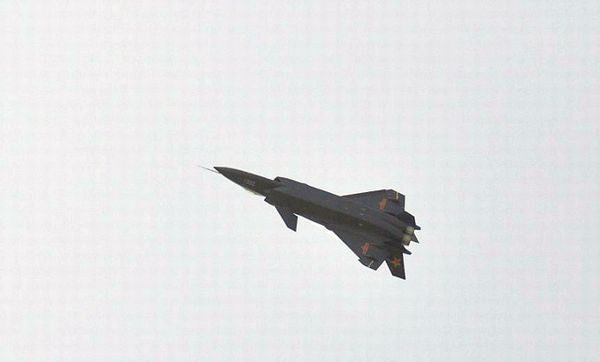
Russia has never transferred any stealth technology to China to assist it with its J-20 Black Eagle fifth-generation stealth fighter prototype, Russian plane maker MiG said.

"We are not delivering any equipment to China, and never have," MiG spokeswoman Yelena Fyodorova said.

MiG's statement follows claims in the Russian and foreign press last week that China's J-20, unveiled over six months ago, is based on technology and components from the Russian Mikoyan Article 1.44, a stealth technology demonstrator aircraft, development of which was suspended.

Some analysts say the aircraft have close similarities.


"The back end of the J-20 looks awfully like the 1.44, as does the overall layout with delta canards," said Douglas Barrie, an air warfare specialist at the London-based International Institute of Strategic Studies.

"If it's a coincidence, it's a striking one. Russia may have provided technical support, but there is nothing substantial to prove that. China has however relied on Russia for much of its defense procurement for a decade and a half," he added.

China's J-20 Black Eagle is thought to be conceptually similar to the U.S. F-22 Raptor and the Russian T-50 jets, but is likely to be just a technology demonstrator or prototype rather than a viable fighter.


China has been working on a future fighter program since the mid-1990s, but the J-20 is not expected to enter service before 2018-2020.

Earlier in the month, Mikhail Pogosyan, the head of Russia's United Aircraft Corporation said that China's fifth-generation fighter program is more for effect than substance and branded the maiden flight as a "show-off."

China relied on the Soviet Union for much of its aviation technology until the Sino-Soviet split after 1961. China then carried on developing copies of Soviet and Russian aircraft.

Beijing also relies on Russian engines, radars and electronic components for many of its other aircraft, such as the JF-17 fighter it developed jointly with Pakistan.

"We are not delivering any equipment to China, and never have," MiG spokeswoman Yelena Fyodorova said.

indrus.in

China's Next Generation Fighter Projects-g J-20,J-19 And J-16 Fighter Jets


CAC didn't get all the projects. SAC also got its own 4th gen. Navy's 4th gen will be a competition between the two. Eventhough SAC has more experience with J-15, CAC will be looking to take their pie.

Both design institutes have their proposals (for navy's 4th gen), but competition hasn't start yet. SAC's convention design has more advantage in this area, since it requires little modification. CAC's design require significan altercation. Navy has requirement for stealth and supercruise, as well as supersonic manoevurability. One more thing, navy's 4th gen will be a heavy fighter.


Decent and objective article. J-20's paylod is quite good compared to its size. It's roughly about the size of T-50 and F-22, smaller than Su-27. Competition for avionics is basically done. If it enters service in about 6 or 7 years, its avionics will be roughly on par with F-35 today. And the dimension of its radar will be the largest among all 4th gen (including F-22, F-35 and T-50).

SAC's avionics will be slightly inferior to CAC's. CAC's avionics were chosen from a competitive process. In terms of payload, SAC's design has more flexibility.

2007's competition was between canard design of CAC and tri-wing design of SAC. It is different from current conventional layout project ongoing at SAC at the moment.
Competition for J-20's sub-systems is already over. We're waiting to intergrate and test them on 03 and 04 prototypes.
When completed, we estimate J-20 will have better avionics than current F-22. Among the 4S requirement, two will likely exceed it. Of course, F-22 will still be better in terms of stealth.

J-20's design philosophy is to meet stealth requirement, while emphasizing on manovurability and supercruise, similar to Mr. Song's (designer of J-10) article.

Even if our turbofan engines are on the same level as Americans, we're still likely to use canards in our design.
WS-15 engine will be equipped with 3D TVC. Russians will do the same thing with their engines. Only Americans will use 2D TVC. Each has its pros and cons, depending on what's more suitable for the user, so don't expect F-22 style nozzle on J-20.

CAC and SAC's projects will both be produced, and used in conjunction. All 4th gen are part of our future air combat network.

Originally, SAC did not plan to install TVC on their project, but now the plan has changed.
Don't expect J-20 to carry anti-ship missiles. It's both impossible and unneccessary. J-20's sole focus is air superiority, carrying 6 medium range and 2 short range air-to-air missiles.

Wednesday

China’s 5th generation Stealth Fighter Program


While the Russian aircraft manufacturer Sukhoi is flight testing its T-50 PAKFA–the world is watching the tests very closely.

Analysts are surprised that China too is testing its 5th generation aircraft (which it calls 4th generation). Beijing thinks that the F-22 is a 4th generation aircraft    while the West considers it a 5th generation stealth fighter. With $30 Billion China building J-xx 5th generation fighter.

Shenyang J-XX: J-12, J-13, F-XX, J-XX (or J-X or XXJ) is a name applied by Western intelligence sources to describe a programme or programmes by the People’s Republic of China to develop one or more new fourth- or fifth-generation fighter aircraft. In 2002,Jane’s Defence Weekly reported that Shenyang Aircraft Corporation had been selected to head research and development of the new fighter, a claim repeated in New Scientist the same week. However, a 2006 article in Military Technology referred to three designs; J-12 & J-14 by Shenyang Aircraft Corporation and J-13 by Chengdu Aircraft Corporation.
According to the report from Jane’s, development of the subsystems, including the engine and weapon suite for the next generation fighter, has been under way for some time.

If we ignore the war of nomenclature–the fact remains that Chinese are at par with or possibly ahead of the Russian stealth race.

As for the Chinese 5th generation fighter (or 4th generation as they call it), it has always been a battle between SAC and CAC. We’ve received a lot of mixed/contradictory news over the so called J-XX in the past few years. People first speculated that it will be developed by SAC due to the model they saw in Zhuhai 2002. 

By 2007, we started to receive news that CAC’s design was actually awarded the contract. At the same time, many people also certainly speculated that China was going to join this project for the longest time, but that never happened. I think that China knew what was at the stake in such a cooperation. They would likely get an offer from the Russians for ToT and some development work. Although, the Russians would freeze the design according to their needs and keep some of the trade secrets to themselves.

China Close To Test 5th Gen Fighter–usually tagged as F-XX, but some call it by the moniker J-14.

A Chinese fighter of nominally the same technology generation as the Lockheed Martin F-22 will soon enter flight testing, while a jet airlifter larger than the Airbus A400M should be unveiled by year-end.
Beijing’s fighter announcement suggests a serious failing in U.S. intelligence assessments, mocking a July 16 statement of U.S. Defense Secretary Robert Gates that China would have no fifth-generation fighters by 2020. Industrial competition looks more remote than strategic competition, however, since China will want to fill domestic requirements before offering the aircraft abroad, even if it judges export sales to be a wise policy.

The new fighter “is currently under development,” says Gen. He Weirong, deputy air force chief. “[It] may soon undertake its first flight, quickly enter flight testing and then quickly equip the forces.
“According to the current situation, [the entry into service] may take another eight to 10 years,” he adds.

No details of the aircraft were given, but it is almost certainly designed for supersonic cruise without afterburning. In April, Adm. Wu Shengli, the navy chief, listed supercruising fighters among equipment that his service needed. Notably, all the other equipment on his wish list looked quite achievable by the end of the next decade, matching the timing that the air force now suggests for the fighter.

China classifies aircraft of the F-22’s technology level as fourth-generation fighters, although they are called fifth- generation aircraft in the West. China’s current advanced fighter, the J-10, is locally called a third-generation aircraft, which in Chinese terms means that it is comparable with the Lockheed Martin F-16.
Work on “the fourth-generation aircraft is now proceeding intensely,” He says.
Whether the upcoming fighter is really comparable with the F-22 remains to be seen. Low radar reflectivity would not be surprising, since aircraft and missiles with stealthy shapes are now popping up in many countries, including South Korea as recently as last month (AW&ST Oct. 26-Nov. 2, p. 42). But sensor performance, information fusion and maximum supercruise speed would also be assessed critically in measuring a claim to have caught up with technology levels that the U.S. did not deploy until 2005.

The existence of a Chinese fifth-generation fighter, usually tagged J-XX, has been rumored for years without official confirmation.

If the aircraft does go into service before 2020, then at that time China may well have jumped past Britain, France and other Western European countries in terms of deployed, domestically developed combat-aircraft technology. That will depend on how quickly those countries move to field combat drones to replace current strike aircraft, says Andrew Brookes of the International Institute for Strategic Studies.
Brookes takes seriously the Chinese objective of technology equivalent to the F-22, and he sees no reason to doubt that the F-22 would be the standard against which they would judge their design. The know-how can be imported.

“The Russians have the technology and the Chinese have the money,” he says. “If they really set that as a target, then I think they can do it.”
The aircraft may not bother Western manufacturers in export markets, Brookes suggests, simply because an equivalent of the F-22 would be a destabilizing export that China would be prefer to keep to itself.
Even if China decides that it wants to export the fighter, Lockheed Martin should by then be well entrenched with the F-35, which should be mature and reliable at that point. Other manufactures may not be so well placed, however.

Gen. He made his remarks during an interview on China Central Television as part of the celebrations of the 60th anniversary of the air force of the People’s Republic of China. 
China is probably working on two fifth-generation concepts, says Richard Fisher of the International Assessment and Strategy Center. One of those concepts, appearing most commonly in bits and pieces of evidence that have turned up from time to time, would be a heavy twin-engine fighter probably of about the same size as the F-22. The other is a single-engine aircraft probably closer to the Lockheed Martin F-35.
Gen. He could be referring to either of the aircraft when predicting an entry into service during the next decade. Fisher’s bet is that he is talking about the twin-engine concept.

Like Brookes, Fisher believes China is realistically aiming at the F-22’s technology level. “One has to assume that the People’s Liberation Army is confident in its projections, as it almost never makes such comments about future military programs, especially one that has been as closely held as its next-generation fighter.

“As such, one has to be asking very hard questions: How did the U.S. intelligence community get this one wrong? And inasmuch as no one expects the F-35 to replace the F-22 in the air superiority role, is it time to acknowledge that F-22 production termination is premature and that a much higher number is needed to sustain deterrence in Asia?”
In his July 16 speech, Gates said that even in 2025 China would have but a handful of fifth-generation aircraft.

The new Chinese fighter could come from the Chengdu or Shenyang plants of Avic Defense.
Gen. He says the Chinese air force plans to emphasize development of four capabilities: reconnaissance and early warning, air strike, strategic supply, and air and missile defense.

The J-10 began large-scale service entry in 2006, state media say.
When Wu raised the prospect of a supercruising fighter, an easy answer seemed to be an advanced version of the J-10. That looks less likely now that He describes the future concept as a full generation ahead of the J-10.

“I believe the Chinese have a difficult road if their design is tied to the J-10,” says a U.S. Air Force officer involved in the development of the F-35. “Significantly reduced signature requires more than coatings. It requires an integrated design philosophy with the right shaping, the right structure and the right surface coatings.”

Fisher assumes that China is developing improved fourth-generation fighters in parallel with the fifth generation.
The existence of the airlifter has been known for several years, if only because pictures of it have appeared fleetingly in presentations by the Chinese aviation conglomerate Avic.

As expected, it turns out to be a product of Avic’s large-airplane subsidiary, Avic Aircraft and, more specifically, of the subsidiary’s core plant, Xi’an Aircraft.

Avic Aircraft General Manager Hu Xiaofeng says the airlifter is in the 200-metric-ton class and will be unveiled at the end of this year.
In fact, its design has already unveiled in pictures shown by state media. The four-engine aircraft adopts the universal high-wing, T-tail configuration. The wing is mounted on top of the circular body, rather than passing through a deep segment of it and cutting out much of the usable cross-section. In that respect it is like the A400M, Ilyushin Il-76 and Kawasaki C-X but unlike the C-17, whose embedded wing presents less frontal area.

The main gear of the Chinese aircraft is housed in very protuberant sponsons, like those of the C-17.
A photograph of the cockpit shows five electronic displays of moderate size and conventional transport-style control columns. Engines are not revealed but would presumably be imported from Russia. A wind-tunnel model shows the engines are enclosed in long nacelles, like those of the Perm PS-90 from Russia.

The PS-90 has a standard maximum thrust of 35,300 lb. in its latest version. The C-17, with a gross weight of 265 tons, is powered by four Pratt & Whitney F117 engines of 40,400 lb. thrust.
The airlifter’s fuselage appears to be of conventional metal construction. The aircraft will be significantly larger than the A400M, which has a 141-metric-ton gross weight.

Hu says it has been independently developed in China. However, his parent company, Avic, has a long history of cooperation with Ukrainian airlifter specialist Antonov.China Close To Testing Next-Gen Fighter | AVIATION WEEK

So, why did China not cooperate with the Russians. I think China realizes that it has enough aerospace technology base to be able to develop a true 5th generation fighter. At the same time, the Russians would always be the primary partner in such a project. It would be hard to imagine China wanting to act second-fiddle and be locked out of a large part of the development process and some of the advanced technologies. By working with the Russians, China would not only pay a majority of the development but also continuously pay Russians for certain parts of the frame, maintenance/repairs, extra supplies of the engine and maybe even missile/avionics cost. In the end, China has enough faith in AVIC1 to be able to develop this fighter.

On November 9, General He Weirong, deputy commander of the People’s Liberation Army Air Force (PLAAF), confirmed long-standing speculations that the PLAAF is developing fifth-generation fighters (fourth-generation in Chinese standard), which may be in service within 8 to 10 years, and certainly by 2020. During an interview with state-owned China Central Television (CCTV) two days ahead of the 60th anniversary of the PLAAF on November 11, Deputy Commander He announced that the next-generation fighter would soon undergo its first flight, closely followed by flight trials (Xinhua News Agency, November 9). The senior military officer’s disclosure reflects the considerable progress that the PLAAF has made in force modernization, which has exceeded Western expectations in terms of the pace of development and the capabilities of its defense industrial base. While China remains several steps behind the United States in operationalizing its advanced fighter jets, the PLA’s rapid military modernization has raised concerns among U.S. allies in the region that the military balance is beginning to tilt toward China’s favor.
In an interview with Global Times, PLAAF Commander Xu Qiliang stated, “superiority in space and in air would mean, to a certain extent, superiority over the land and the oceans” (Global Times, November 2), thereby highlighting the PLAAF’s position in Chinese military planning. At an event commemorating the PLAAF’s 60th anniversary, President Hu Jintao heralded a “new chapter” in the development of the PLAAF (Global Times, November 10).
China’s fifth-generation fighters will reportedly have 4S capabilities: stealth, super cruise, super maneuverability and short take-off. According to Air Force Colonel Dai Xu, “its most striking characteristic is the capability of invisibility, which also could be called low detectability” (Global Times, November 10). The U.S. F-22 Raptor serves as the gold standard of fifth-generation fighters, which is currently the only fifth-generation fighter in service among all the world’s armed forces. According to General He’s interview, Chengdu Aircraft, the country’s leading fighter manufacturer, is reportedly developing the fighter with Shenyang Aircraft (Xinhua News Agency, November 9).

General He’s startling revelation that the next-generation fighter may be in service by 2020 stands in stark contrast to the Chinese habit of closely guarding its military capabilities, yet consistent with a recent trend that reflects the Chinese Armed Force’s growing confidence in its military strength. During an interview with the official Xinhua News Agency back in September, Defense Minister Liang Guanglie proclaimed that, “Our [China’s] capabilities in waging defensive combat under modern conditions have taken a quantum leap … It could be said that China has basically all the kinds of equipment possessed by Western countries, much of which reaches or approaches advanced world standards” (Xinhua News Agency, September 21),.

Indeed, an ongoing survey conducted by Global Times among its Chinese users revealed some telling observations about how they perceive China’s security environment and PLA airpower. The short four-question survey asks the respondents questions ranging from where they think the biggest security threat to China in the future will come from to how they rate China’s airpower and what type of air force should be developed in the future. The first question, which asks how respondents view China’s security environment, 46 percent of the 9,335 who answered said that they think the biggest security threat to China comes from the sea, while 43 percent responded that it is airborne. The second question asked respondents to rate China’s air force, and 50.8 percent rated the Chinese Air Force as average, while 44.9 percent rated it as weak. The third question asked respondents what kind of airforce China should develop, and an overwhelming majority, 75.3 percent, responded that China ought to develop a strategic air force capable of covering the entire globe. The final question asks respondents where China should place its emphasis with regard to air force development, and the majority—47.6 percent—responded that China’s air force should develop a space-based combat unit (satellites, space weapons, etc.), while 21.3 percent responded that China’s emphasis should be placed on developing large airlift platforms (strategic bombers and cargo aircraft, etc.) (Survey.huanqiu.com, November 17).

In light of China’s rapid air force modernization, Japan is increasingly concerned about Chinese regional air superiority. A Kyodo News report cited by the Global Times quoted Andrei Chang, editor-in-chief of the Canada-based Kanwa Defense Review Monthly, as saying that the PLAAF currently has 280 J-11s, whose combat performance is comparable to Japan’s Air Self Defense Forces’ 200 F-15s, and 140 J-10s, which are a match for the F-16s. According to a Japanese military source, “even though [Japan] has a disadvantage in numbers at the moment, but combined with its airborne early warning and control system Japan can win in terms of quality.” Yet, the source cautioned that, “once China deploys its AEWC [KJ-2000, which were on display at the October 1 National Day Parade] … Japan’s air superiority will gradually diminish” (China Daily, November 11; Global Times, November 12). 

Recently, we’ve received two pieces of news. The first one is an enthusiastic report on WS-15. The article just got really excited about using digital design for developing WS-15, but it did not really explain how well the project really is doing. According to some online sources, the engine should be ready in the middle to later part of next decade.
The thrust performance is designed toward matching F-119, but it’s hard to think that WS-15 would be as reliable and stealthy as F-119. We also got one final confirmation from CAC that they got the main design work for the 5th generation fighter. Now, the production facility of SAC may still be used to produce a large part of the 5th generation fighter, but PLAAF clearly likes CAC’s design better. SAC will be saddled with the design for the naval fighter, future J-11 variants and UAV/UCAVs.

CAC now has the upgraded J-10, the 5th generation fighter, the global hawk-like UAV and the JF-17 projects to work on. After SAC is done with J-8IIs (hopefully soon), SAC basically only has J-11 variants and UAVs to work on. Also, what does XAC have after JH-7A? I presume bomber or fighter-bomber projects, but there really isn’t a good report verifying much of anything. Also, it’s interesting that PLAAF selected CAC’s design over SAC despite neither firm having built a prototype. 
CAC will now be in charge of getting some built soon that will use 2 WS-15 engine (or maybe WS-10 series in the beginning), radar (by probably 14th institute) and integrating different avionics together. CAC is already getting a lot of experience developing a new generation of avionics on the upgraded J-10. The 5th generation plane should take that up a notch to be able to fighter in the new environment. A new generation of missiles are also being developed for future fighters. We’ve seen/heard a 5th generation SRAAM, a successor MRAAM to PL-12 and a Metor-like ramjet powered LRAAM. CAC has shown that it can integrate all of this in the J-10 project. So, I think PLAAF is making the right decision to pick it ahead of SAC for the 5th generation design work. At current time, I’ve been reading 2015 as the year that this plane will join service. I think this is kind of optimistic, because they are not expecting first flight until 2012.

Sunday

India orders study on J-20


Two days before retiring from service, Air Marshal SC Mukul, the chief of India's Integrated Defence Staff (IDS) has instructed a Group Captain-rank officer at HQ IDS to prepare a report on the recently revealed Chinese stealth fighter prototype. The report will be India's official assessment of what, by all accounts, is a Chinese fifth generation platform.


The study will, of course, rely mostly on open source material -- photographs, graphics, unofficial assessments -- on the J-20, though a source of mine indicates that the the officer entrusted with authoring the report will also take inputs from the IAF Directorate of Operations, the Directorate of Naval Aviation, the advanced projects and AMCA divisions of the Aeronautical Development Agency (ADA), the National Aerospace Laboratory (NAL), the Aircraft Research & Design Centre at HAL, apart from the R&AW. The report will be provided to the Indian Air Force and the office of the National Security Advisor. The HQ IDS orders studies on foreign weapon programmes as a matter of routine. These assessments, obviously remain classified though files on Pakistan's air force strength did leak in 2007.


Engine od Chinese Fifth Generation Fighter J-20 Black Eagle


The R & D projects in China-made engine has some defects, the engine can not be widely used in military aircraft. As we all know, the Chinese improved strategic bombers H -6 equiped with the Russian-made D-30KP engine, JF-17 fighter with the RD-93 engine, J -10 with the AL-31FN engine, J-11 with AL -31F engines.
According to the Russian Military industry News site on December 29 News reported that China's aviation enthusiasts, the 5th generation fighter first clear picture of the most amazing Christmas gifts. J -20 J -14 or code, or J-XX aircraft was taxiing at high speed, "passers, " found that after taking to the web. Perhaps this is to demonstrate transparency, perhaps the country's military strength increasingly strong and proud of China's industrial spun leakage. In short, the new aircraft's engines roar in the Tiger, and now the remaining question is what kind of new aircraft in the end with the engine.


World experts generally believe that China-made engine R & D projects has some drawbacks, not widely used in military aircraft. As we all know, the Chinese strategic bombers H -6 improved engine assembly of the Russian-made D-30KP, JF-17 fighter using the RD-93 engines, J -10 with the AL-31FN engine, use the AL J -11 -31F engines. In short, the engine of China in Russia there is heavy reliance on imports, this trend is likely will continue. According to Russian media and the United Kingdom, "Jane's Defense Weekly " unconfirmed information, Russia has for the Chinese J–14 provides its own prototype of the 117S engine the latest (5th generation Russian fighter T-50 also uses this type of engine) But the news has been questioned. However, on the other hand, the Chinese-made WS-15 engine with the same look less credible, because this engine is not perfect, can not be used to verify the assembly of new machines. In short, China's 5th generation fighter in the end use of the type of engine, is still unknown.

Chinese J-20 J-XX Fifth Generation Stealth Fighter Combination Of F-22 Raptor And T-50 Stealth Fighter Designs

The emergence of J-20 shook the media in the past ten years have no expectation on the aviation industry in China , J-20 seems to be a major step forward in the Chinese air force signals, it appears that that the PLA Air Force has grown up No longer need to rely on outdated Russian or Israeli fighter design. 

U.S. Defense News article said that the United States in 1990 had a secret test flight of the F-22 and its competitive model F-23 prototype. Five air superiority fighter currently in terms of whether China has caught up with the U.S.? Recently popular Chinese Web sites everywhere in the People's Liberation Army's newest jet fighter J-20 (F 20) obscure the picture. Some people think these pictures are fake; Also some people think that picture is real, and J-20 project has been well under way. Some analysts argue that these images may be the Chinese government has launched a product of information warfare.


The article said that some of the Internet forums in China have reproduced the J-20 picture, picture show that the aircraft has many typical characteristics of the shape of the Five machines, including the distinctive outline of the front nose, irregular triangular wings and a motor upgrade of the tail. Judging from the plane shape, the Chinese J-20 looks more like the U.S. Air Force F-22 fuselage and the front of the latter part of the Russian T-50 airframe combination.

J-20 has been shaken by the emergence of China's aviation industry more than a decade did not have expectations of the media, J-20 seems to be a major step forward in the Chinese air force signals, it appears that that the PLA Air Force has grown up no longer need to rely on outdated Russian or Israeli fighter design.

Article analyzed, the question now is, J-20 is the emergence of the United States dominate the world aerospace end? Analysts are still nervous F-22 and will be F-35 as a world-class, but when Russia's newest fighter T-50 flight and the Chinese J-20 appears, analysts knock on the status of the U.S. Air Force sound the alarm.

The Pentagon delayed production of F-35, but at the same time, China has been significantly accelerated the development of national secrets Five aircraft rate of progress.

Up to now, J-20 has not yet been flight. F-22 from the first flight to enter service with the U.S. military for 15 years, taking into account the high technology of China's quality control problems, J-20 high-volume service may take years or even longer, which will be the balance of power in the Pacific have some impact. From this we can see that the Chinese Air Force, Defense Secretary Robert Gates, to judge and assess the possible bias a little, but not a lot of bias.

Chinese Fifth Generation Stealth Fighter J-20 Black Eagle


The J-20 #2001 prototype was photographed when it was preparing for high-speed taxi trial at the CAC airfield in late December 2010, wearing a distinctive dark green color scheme (RAM coating applied?). The prototype features a pair of all-moving tailfins and Russian 1.44 style ventral stabilizing fins, which shield the engine nozzles but might increase RCS. 

It also features an F-22 style forward fuselage, including Caret intakes but with DSI bumps installed at the upper inner corners, as well as a one-piece frameless canopy. However the canards appear to extend slightly above the plane of the main wings and there are four large underwing actuator fairings which might not be stealth optimized. First disclosed by US Office of Naval Intelligence (ONI) in 1997 as XXJ, J-20 is the 4th generation multi-role fighter to enter the service between 2015 and 2018. Since 90s both CAC/611 Institute and SAC/601 Institute had been working their own designs for a twin-engine multi-role heavy fighter with stealth capability and maneuverability comparable to American F-22.


It was speculated that 601 Institute was working on a "tri-plane" design (J-18?) based on canard/conventional layout/V-shape tailfin while 611 Institute working on a design based on canard/tailless delta wing/all moving V-shape tailfin/lateral DSI/bump inlet layout. All designs were expected to feature an internal weapon bay to reduce RCS, which has been speculated to be <0.05m2 (head-on). J-20 also incorporates an advanced FBW system fully integrated with the fire-control and the engine systems. Its fire-control radar is expected to be AESA (Type 1475/KLJ5?). The aircraft may feature a "pure" glass cockpit (a single F-35 style color LCD display and a wide-angle holographic HUD).

Many of these subsystems have been tested onboard J-10B to speed up the development (see above). The exact type of engine powering J-20 prototypes is unclear, even though a Russian turbofan engine such as 117S or 99M2 (14t class) or D-30F6 (15t class) with an axisymmetric TVC nozzle has been speculated. It was reported in November 2006 that a T/W=10 17t class turbofan (WS-15/"large thrust") is being developed and will eventually power J-20. Russian assistance was also speculated in terms of software support for calculating the RCS of various designs. The overall performance of J-20 is thought to be superior to that of Russian T-50 (maneuverability & supercruise) but still inferior to that of American F-22 (electronics & supercruise). In August 2008 it was reported that 611 Institute was selected to be the main contractor for the development of J-20 and 601 Institute as the sub-contractor. Subsequently a full-scale metal mockup was built at CAC. 


One rumor in May 2010 claimed that 611 Institute started to construct the first prototype, which was expected to fly by the end of 2010, even though the full configuration model won't fly until a few years later. Currently two prototypes (#2001 & 2002) have been constructed and the first high-speed taxi trial by 2001 took place on December 22, 2010.

The Clearest Pictures Of Chengdu J-20 Fifth Generation Stealth Fighter Jet


Clear Pics of J 20 length


Chinese J-20 Black Eagle Stealth Fighter In Taxi Trials


China’s first known stealth aircraft just emerged from a secret development program and was undergoing high-speed taxi tests late last week at Chengdu Aircraft Design Institute’s airfield. Said to be designated J-20, it is larger than most observers expected—pointing to long range and heavy weapon loads.
Its timing, Chengdu’s development record and official statements cast doubt on U.S. Defense Secretary Robert Gates’s 2009 prediction (in support of his decision to stop production of the Lockheed Martin F-22) that China would not have an operational stealth aircraft before 2020.

The debut of the J-20 was announced in a November 2009 interview on Chinese TV by Gen. He Weirong, deputy commander of the People’s Liberation Army Air Force. The general said a “fourth-generation” fighter (Chinese terminology for a stealth fighter) would be flown in 2010-11 and be operational in 2017-19.
The J-20 is a single-seat, twin-engine aircraft, bigger and heavier than the Sukhoi T-50 and the F-22. Comparison with ground-service vehicles points to an overall length of 75 ft. and a wingspan of 45 ft. or more, which would suggest a takeoff weight in the 75,000-80,000-lb. class with no external load. That in turn implies a generous internal fuel capacity. The overall length is close to that of the 1960s General Dynamics F-111, which carries 34,000 lb. of fuel.
The J-20 has a canard delta layout (like Chengdu’s J-10) with two canted, all-moving vertical stabilizers (like the T-50) and smaller canted ventral fins. The stealth body shaping is similar to that of the F-22. The flat body sides are aligned with the canted tails, the wing-body junction is clean, and there is a sharp chine line around the forward fuselage. The cant angles are greater than they are on the Lockheed Martin F-35, and the frameless canopy is similar to that of the F-22.

The engines are most likely members of the Russian Saturn AL-31F family, also used on the J-10. The production version will require yet-to-mature indigenous engines. The inlets use diverterless supersonic inlet (DSI) technology, first adopted for the F-35 but also used by Chengdu on the J-10B—the newest version of the J-10—and the Sino-Pakistani JF-17 Thunder.
The main landing gears retract into body-side bays, indicating the likely presence of F-22-style side weapon bays ahead of them. The ground clearance is higher than on the F-22, which would facilitate loading larger weapons including air-to-surface munitions. Chinese engineers at the Zhuhai air show in November disclosed that newly developed air-to-ground weapons are now required to be compatible with the J-20.
Features at the rear of the aircraft—including underwing actuator fairings, axisymmetrical engine exhausts and the ventral fins—appear less compatible with stealth, so the J-20 may not match the all-aspect stealth of the F-22. There are two possible explanations for this: Either the aircraft seen here is the first step toward an operational design, or China’s requirements do not place as much stress on rear-aspect signatures.
The major open question at this point is whether the J-20 is a true prototype, like the T-50, or a technology demonstrator, with a status similar to the YF-22 flown in 1990. That question will be answered by whether, and how many, further J-20s enter flight testing in the next 12-24 months.

Developing an effective multi-mission stealthy aircraft presents challenges beyond the airframe, because it requires a sensor suite that uses automated data fusion, emission control and low-probability-of-intercept data links to build an operational picture for the pilot without giving away the aircraft’s own location.

A rapid development program would be a challenge for China’s combat aircraft industry, which is currently busy: The J-10B, FC-17 and Shenyang’s J-11B and carrier-based J-15 are all under development. However, the progress of China’s military aviation technology has been rapid since the first flight of the J-10 in 1996, owing to the nation’s growing economy and the push by the People’s Liberation Army for a modernized military force in all domains. Before the J-10, China’s only indigenous production combat aircraft were the Shenyang J-8 and Xian JH-7, reflecting early-1960s technology from Russia and Europe.

Engine development has lagged airframe development, with reports that the Shenyang WS-10 engine, slated to replace Russian engines in the J-11B, has been slow to reach acceptable reliability and durability levels. That may not be surprising, given that high-performance engine technology is founded on specialized alloys and processes that often have no other uses. (The existence of the J-11B, essentially a “bootleg” version of the Su-27, has been a strain on relationships between the Russian and Chinese industries.)

Progress with avionics may be indicated by the advent of the J-10B, with new features that include a canted radar bulkhead (normally associated with an active, electronically scanned array antenna), an infrared search-and-track system, and housings for new electronic warfare antennas.

One question that may go unanswered for a long time concerns the degree to which cyberespionage has aided the development of the J-20. U.S. defense industry cybersecurity experts have cited 2006—close to the date when the J-20 program would have started—as the point at which they became aware of what was later named the advanced persistent threat (APT), a campaign of cyberintrusion aimed primarily at military and defense industries and characterized by sophisticated infiltration and exfiltration techniques.

Dale Meyerrose, information security vice president for the Harris Corp. and former chief information officer for the director of national intelligence, told an Aviation Week cybersecurity conference in April 2010 that the APT had been little discussed outside the classified realm, up to that point, because “the vast majority of APT attacks are believed to come from a single country.”

Between 2009 and early 2010, Lockheed Martin found that “six to eight companies” among its subcontractors “had been totally compromised—e-mails, their networks, everything,” according to Chief Information Security Officer Anne Mullins.

The way in which the J-20 was unveiled also reflects China’s use and control of information technology to support national interests. The test airfield is located in the city of Chengdu and is not secure, with many public viewing points. Photography is technically forbidden, but reports suggest that patrols have been permitting the use of cell phone cameras. From Dec. 25‑29, these images were placed on Chinese Internet discussion boards, and after an early intervention by censors—which served to draw attention to the activity—they appeared with steadily increasing quality. Substantial international attention was thereby achieved without any official disclosures.

Chinese J-20 US vs F-22 vs Sukhoi T-50 Stealth Fighters


Chinese J-20 Black Eagle vs US F-22 Raptor vs Sukhoi T-50 Stealth Fighters

J-20 Black Eagle Chinese Stealth Fighter

Chinese Fifth Generation Stealth Fighter J-20 Black Eagle


Add caption


India Speed Up Work On PAK-FA After Getting Competetion From Chinese J-20

  India and Russia should speed up work on their joint fifth-generation fighter plane to meet the challenge from the Chinese rival unveiled earlier this week, said a leading military expert.

“The Chinese prototype of a fifth-generation aircraft, J-20, appears to be a long-range strike aircraft and as such it will pose a potential threat to India,” said analyst Konstantin Makienko of the Moscow-based Centre for Analysis of Strategies and Technologies (CAST).

China's stealth fighter made its first 15-minute flight on Tuesday over an airfield in the south-western city of Chengdu. Mr. Makienko called the test flight an “unquestionable success” for the Chinese defence industry.
“China has emerged as the third nation developing the fifth-generation fighter plane after the U.S. and Russia,” he told The Hindu.
The Russian expert said India and Russia should intensify efforts to build their advanced fighter plane if they are not to lose the race to China.
“The J-20 fighter will be a direct rival of the Russian-Indian fifth-generation aircraft. The Chinese plane will be ready by 2020, so time will be a crucial factor.”

The Russian prototype, T-50, made its first flight a year ago. India joined the project only last month when the two sides signed a contract for the preliminary design of the fifth-generation fighter aircraft to be called Perspective Multi-role Fighter (PMF).


India will contribute about 30 per cent of the plane's total design by providing composite material components, some avionics, electronic warfare systems and cockpit displays. Indian designers will also be responsible for re-modelling Russia's single-seat fighter into a two-seater version for the IAF.

The PMF planes are expected to start rolling out around 2017, but delays cannot be ruled out, judging by past experience.
The fifth-generation fighter will be the first Indo-Russian aviation project that will be marketed in third countries.

The Russian Center for Analysis of International Weapons Trade estimates the global market for the PMF at over 400 planes.
“In order to retain its competitive edge the Russian-Indian fifth-generation fighter should enter global markets before the Chinese plane and cap its price at $80-100 million per aircraft,” the Russian expert said.
To rival China's new stealth jet

Chinese Fifth Generational Stealth fighter J-20 Black Eagle Goes To The Skies

China confirmed the first test flight of its highly controversial stealth fighter, ending speculation that the secretive aircraft had taken to the air. Chinese President Hu Jintao told U.S. Defense Secretary Robert Gates 
about the flight of the prototype J-20 shortly before Gates left Beijing after a three-day visit to China intended to improve military communications between the two countries. Gates, who is also visiting Japan and South Korea while in the region, said the discussion with Hu about the J-20 flight that took place this week was short. "I asked President Hu about it directly and he said that the test had absolutely nothing to do with my visit and had been a pre-planned test. And that's where we left it." 


The 15-minute flight took place in Chengdu, in southwest China. Hu, who is chairman of the Central Military Commission, said the flight hadn't been timed to coincide with Gates's visit. The 11-member commission issues directives to the army including senior appointments, troop deployment and arms spending. The majority of members are senior generals but several senior Communist party members are on the commission, a move said to ensure that the military remains loyal in its actions toward the government. Defense and aviation analysts have been questioning images and video clips of the stealth fighter seen on Chinese Web sites since last month, showing what looks like a J-20 standing on a runway apron and then taking off. Many of the shots of the Chengdu J-20 appear taken by people standing a long way from the runway, possibly outside the airport perimeter. 


The aircraft was officially announced in late 2002 as being under development through a joint design and development project by the Chengdu Aircraft and Shenyang Aircraft companies. But Chinese political leaders and aviation sector professionals have been guarded about details, specifications and development progress of the aircraft that is similar in concept to Lockheed Martin's F-22 Raptor stealth fighter. However, experts have gleaned much information over the years. The latest shots show an elongated airframe with forward canards, a main delta wing, outward canted fins, two small ventral fins, two under-wing diverterless supersonic intakes and conventional jet nozzles.

It is believed to be larger than the F-22 -- the only truly stealth plane operational -- or Russia's prototype stealth fighter, the Sukhoi T-50, which had its first test flight in January 2010 and is expected in service sometime after 2015. It isn't clear what engine the J-20 is using. There was some speculation that the Russians may have supplied the 32,000-pound thrust 117-S engine because the Chinese-made WS-10A isn't ready. The 117-S is an upgrade of the Saturn AL-31 turbofan engine developed by Lyulka, now NPO Saturn, of Russia. It was originally made for the Sukhoi Su-27 fighter. It also remains open whether the plane uses plasma stealth technology whereby it emits an ionized gas that surrounds the aircraft, making it harder to detect by radar systems.
Related Posts Plugin for WordPress, Blogger...
Web Analytics